





Edward Lim, CFA

At the start of the US-Soviet Cold War, President Dwight Eisenhower delivered a speech at the National Defense Executive Reserve Conference in Washington. He was addressing largely civilian leaders, urging them to prepare their companies and their personal faculties in the event of a prolonged Cold War. The timing of the speech was particularly tense because, just weeks earlier, the USSR had launched Sputnik 4, intensifying fears in America that the Soviet Union was overtaking it in space and posing a significant military threat. In that speech, he said, “Plans are worthless, but planning is everything,” and “if you haven’t been planning, you can’t start to work, intelligently at least.” Managing investment portfolios is all about planning. Sometimes the plan turns out to be wrong, but in planning for a particular course of action, one has inadvertently also considered alternatives.
In our last Navigator, World in Motion, we stated that even as the global economy slowed due to rising oil prices, it would remain resilient, supported by the trifecta of an AI spending boom, the lift it provides to many parts of the economy, and very healthy corporate profits. Inflation would remain troublesome but, on balance, a weakening labour market would prompt the Fed to cut as its next move, opting to support “maximum employment” over “price stability”. The first two propositions have held true, but the third, on Fed to ease, has not. On 16 September, the Fed raised its target range by 25bps to 3.75–4.00% after holding rates for nine months. And as President Eisenhower said in the same speech, when your planning is wrong, “the first thing you do is to take all the plans off the top shelf and throw them out the window and start once more.”
The wrestle here is that while the economy has strengthened, so has inflation, and it is now posing a bigger concern than the languishing labour market. At the micro level, earnings estimates are rising and equity valuations have become more reasonable. Yet the prospect of further monetary tightening threatens this four-year-long bull market. Three decades in this industry have humbled me enough to respect the maxim, “Don’t fight the Fed”. We retain a neutral allocation to equities and an underweight in bonds, look to rebuild our gold holdings, and retain meaningful exposure to hedge funds.
Our three familiar lenses, nowcasting, purchasing managers’ surveys and consensus forecasts, not only continue to point away from recession, but also towards a global economy that appears to be re-accelerating. The near-term recovery has been stronger than the longer-term forecast revisions might suggest. Nevertheless, the downgrades in longer-term forecasts since the war broke out have also stabilised for most regions.
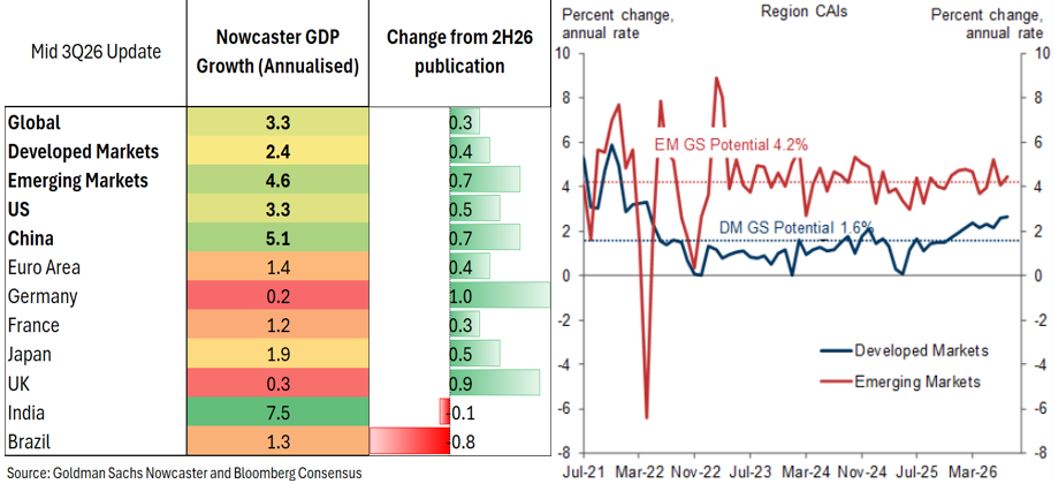
The Nowcaster put annualised global growth at 3.3%, an improvement of 0.3 percentage points from our previous quarter’s update and well above long-term potential. Developed markets have strengthened to 2.4% and emerging markets to 4.6%. The US is running hot at 3.3%, while China has stabilised at 5.1%. India and Brazil are exceptions to the improvement in momentum, although slower growth should not be confused with contraction.
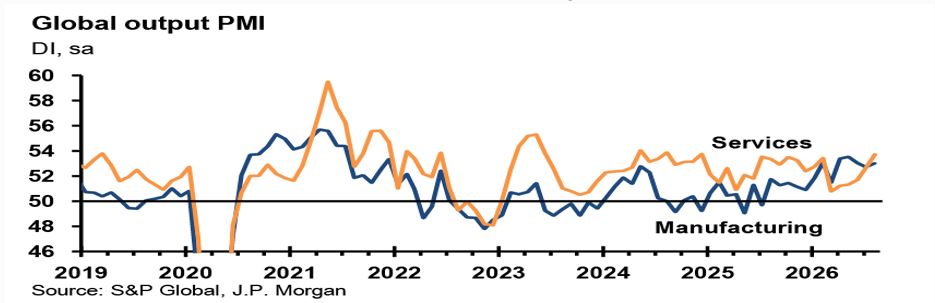
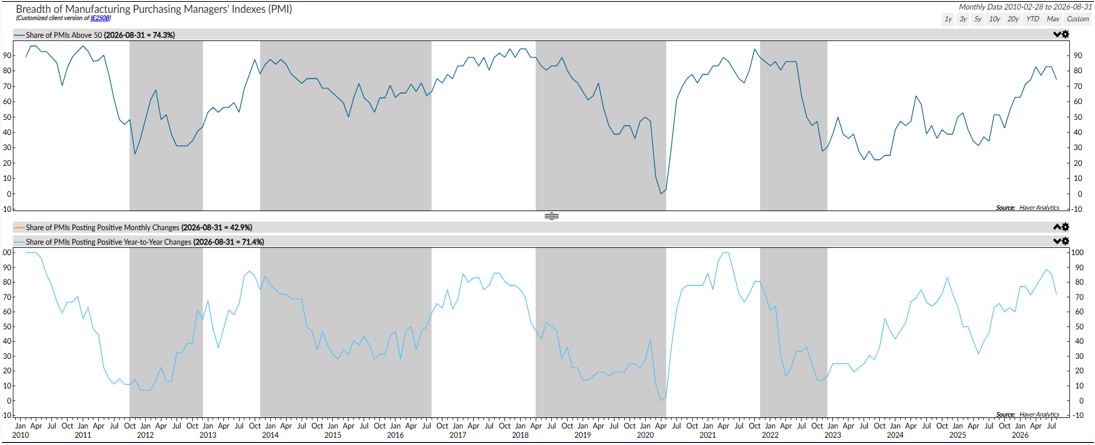
August’s global PMI rose for a fifth consecutive month to 53.5, consistent with approximately 3.1% annualised growth. Manufacturing remains supported by AI investment, while services have recovered from their earlier softness. Expansion is broad, with 74% of tracked manufacturing PMIs above 50 and 71% having improved from a year earlier, even as month-on-month momentum is choppy.
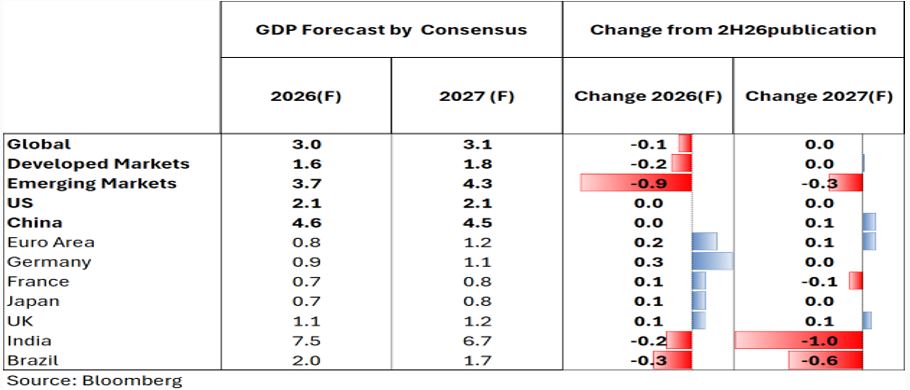
Looking further out, consensus forecasts put global growth at 3.0% in 2026 and 3.1% in 2027, with the US at 2.1% in both years. Emerging-market forecasts have suffered larger downgrades than those for developed economies, stemming from weakness in the GCC and in countries sensitive to imported oil, such as India. Nonetheless, the aggregate picture remains one of expansion.
Unfortunately, the improvement in growth comes against the backdrop of another surge in crude oil and downstream products, from diesel to fertilisers, while renewed supply-chain pressure has all but reversed the disinflation trend seen in the first half of the year. Take the US as an example. Monthly readings show renewed pressure across both headline and core inflation, including goods and services. A central banker can look through a temporary increase in petrol prices. It becomes harder when the pressure spreads to the rest of the shopping basket.
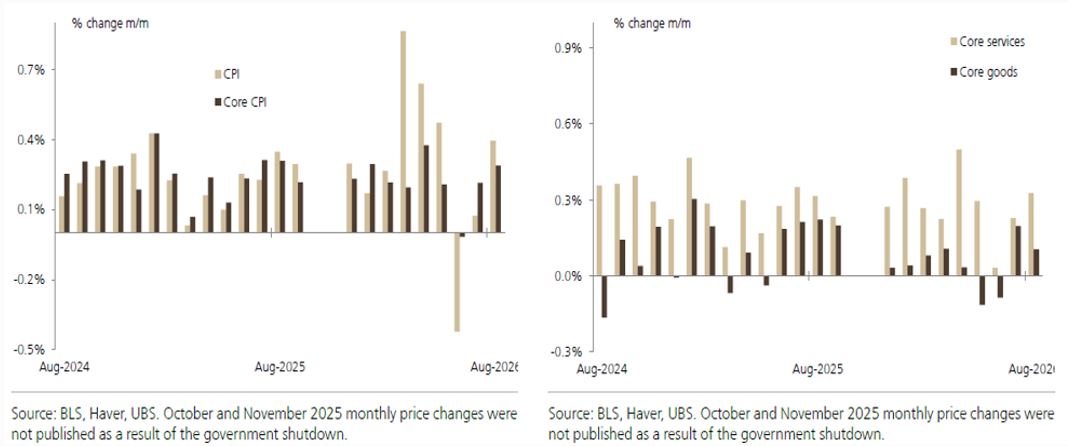
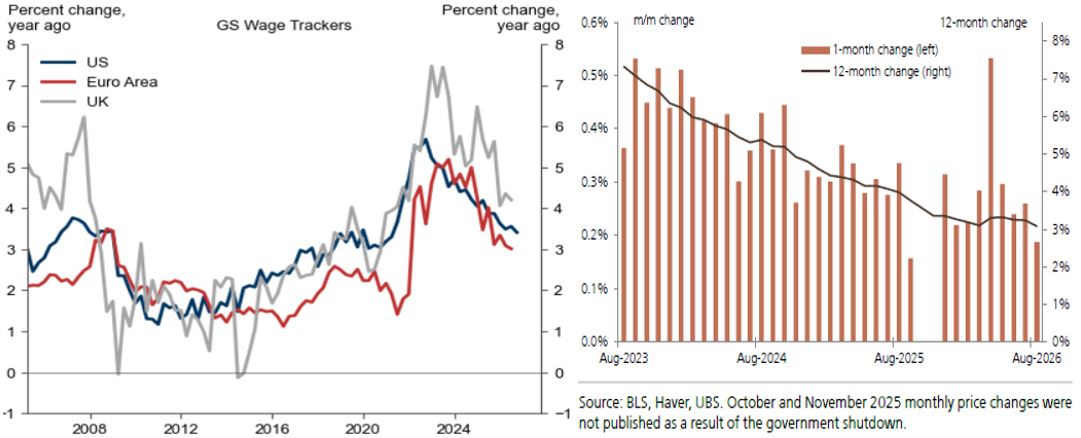
We still think there is a credible case for inflation to ease towards the Fed’s target in 2027 as the effects of tariffs wane, wage growth slows, and the rent components of CPI continue to ease, consensus forecasts put US CPI at 3.3% this year, falling to 2.4% next year. There are also one-off adjustments in 1H26 CPI numbers such as higher financial-services and software pricing that will not be present in future computations. We will keep marking the four main variables driving inflation: oil, goods prices, wages and rents. The first two have become less comfortable, but the latter two still offer some relief.
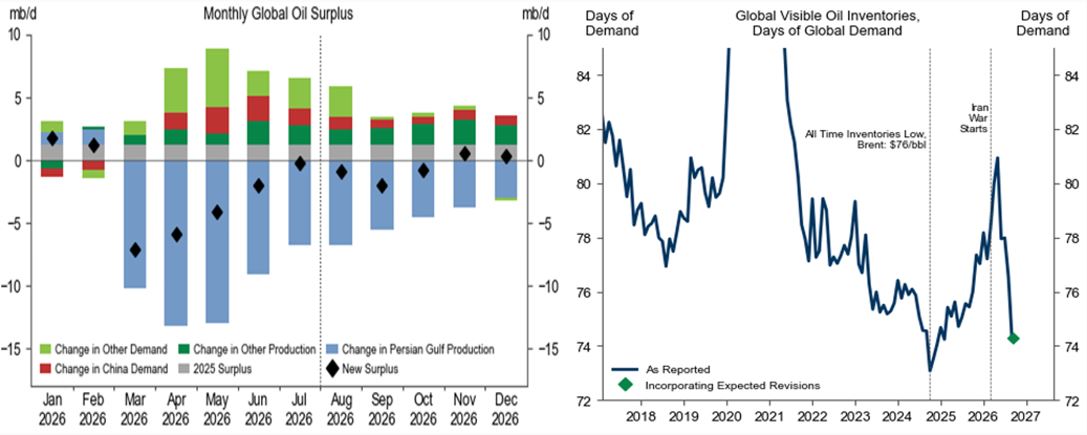
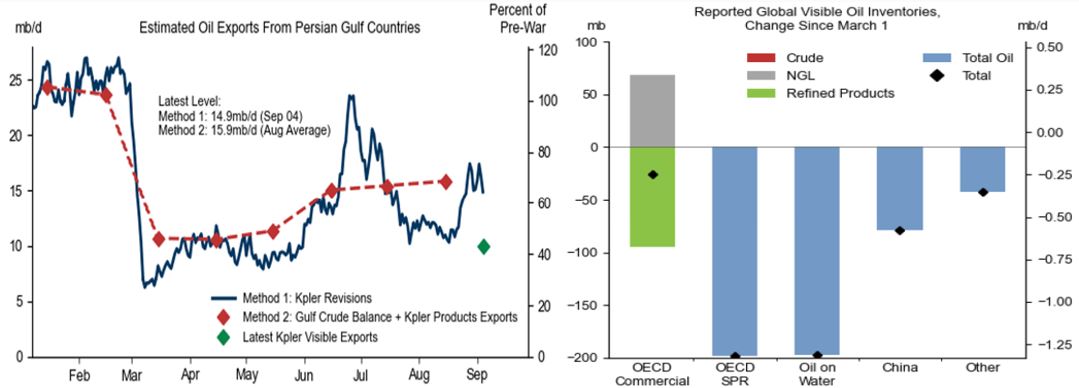
In our last publication, World in Motion, we explained why the initial oil shortage had proved less destructive than feared. Consumers adapted, supply outside the Gulf increased, throughput through the Straits was greater than feared, while inventories absorbed the shortfall. The oil-balance model now estimates that the global deficit narrowed from about 7 million barrels a day in March to around 1 million in the third quarter. That is a substantial improvement. But the stockpile that made this adjustment possible is depleting. Visible global inventories have fallen by more than 500 million barrels since March, towards the lower end of the available historical range. Measured against demand, cover has retreated towards 74 days, leaving the supply chain less able to absorb another interruption.
The composition of oil inventory matters too. The significant drawdown in strategic reserves and oil on water helped bridge the disruption, but both are now close to safety-level thresholds. The remaining source of inventory is OECD commercial inventory. That has remained broadly unchanged and close to its recent average, but these are barrels available at a market price. Their owners have little reason to provide the same insurance on the same terms as an emergency reserve release. The combination of uncertain flows and thinner inventories raises the risk of another price shock. The economy survived the first disruption better than feared. Repeating the exercise with less buffer would be harder.
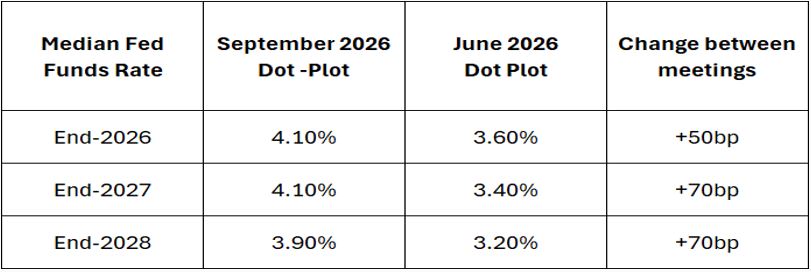
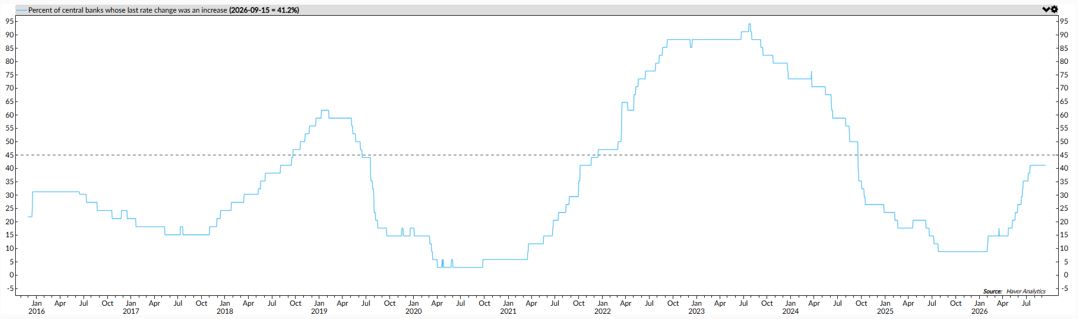
Our earlier expectation of a cut placed considerable weight on labour-market softness and the Fed’s willingness to look through a supply shock. That balance has shifted. Stronger activity gives the Fed more room to confront inflation, while the persistence of price pressure makes waiting untenable. The latest dot plot suggests another hike by the end of the year, which we think will likely come in December to avoid accusations of politicization. It has also removed the previous projection of a rate cut in 2027. We lean towards a shallow hiking cycle, with subsequent decisions depending on the inflation mix and developments in energy markets. Elsewhere, the share of central banks whose last move was a hike has risen to 41.2%. That is a meaningful turn towards tightening, but still far from the last tightening cycle in 2022–2023.
Equities: Still neutral in the short term, but interesting long-term entry points are emerging.
With the Fed moving again, it is tempting to reactivate muscle memory of what happened in the last tightening cycle of 2022–2023 when holding neither equities, bonds nor even gold made you money, let alone provided diversification from one another (MSCI World Equities fell 20%, Global Bond 17% and gold 1%). History offers a more discriminating answer. We examined twelve first-hike episodes from 1971 to 2022. In the short term, in ten of the twelve episodes, the S&P 500 was lower three months later. The average decline was 4.1% and the median 2.1%. It does not help that we are also running into midterm elections, which have tended to be negative for equities as well. Each on its own is sufficient reason to respect the near-term risk.
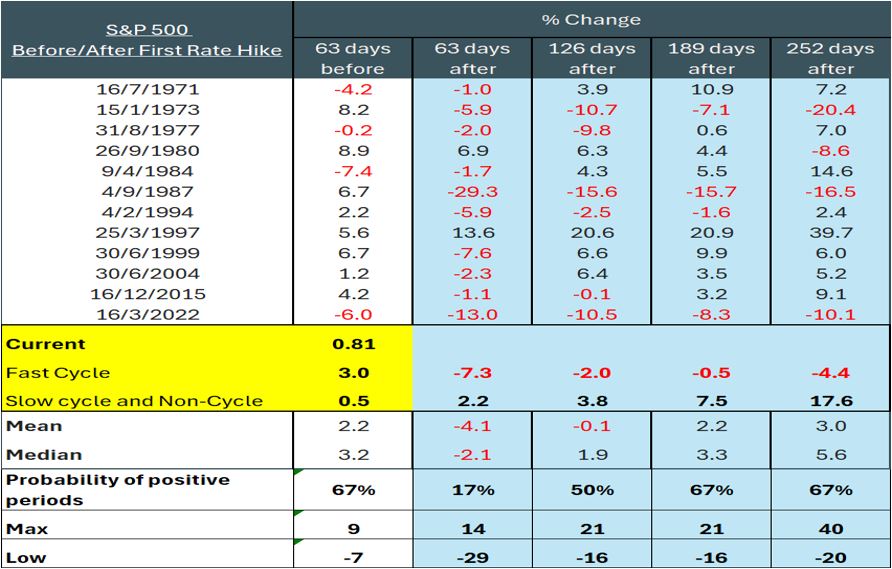
However, the longer horizons are more optimistic. After six months, outcomes were evenly divided and the average return was approximately flat. Nine months and a year out, the probability of positive returns improved to 67%, with mean returns of 3.0% and 5.6%, respectively. When we distinguish returns in a fast-hiking cycle from those in a slow/non-cycle (fast cycle is defined as the Fed hiking at each meeting versus slow cycle across a longer schedule of meetings and non-cycle are often), outcomes differ materially. As we are in the camp that this is likely a mid-cycle hiking adjustment, with subsequent decisions characterised by data dependence, history points to positive returns after a first hike, with the return profile improving as the months pass (first month: +2.2%, sixth month: +3.8%, ninth month: +7.5%, twelfth month: +17.6%).
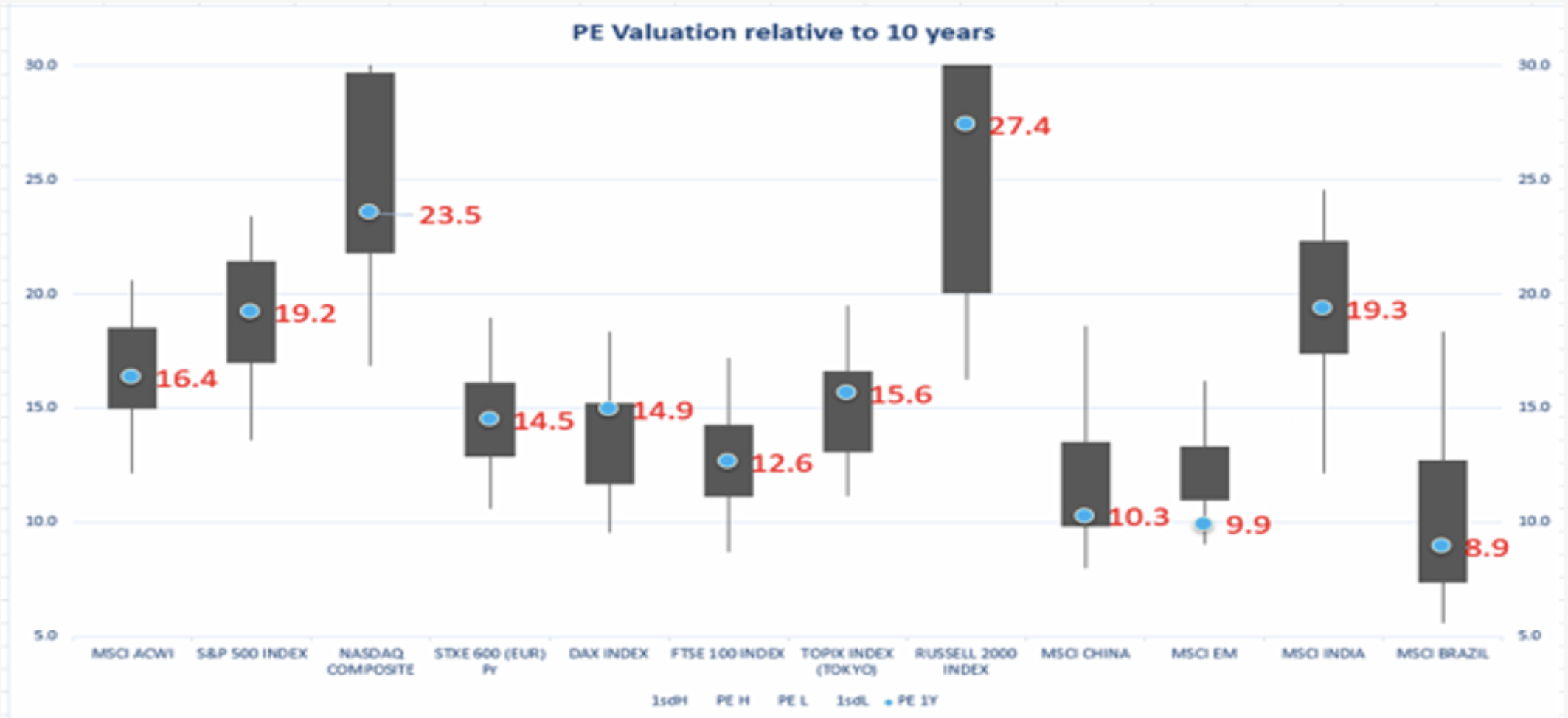
In the current environment, we think what matters more for equities is less about the Fed’s pace of tightening and more valuations, together with the risk of overestimating earnings. As shared by my colleague in Equity Views 2Q26: The AI Debate: Separating Fundamental Momentum versus Price Momentum, he laid out the case for strong AI adoption and the phenomenal economics of AI compute, which have led to a continuous increase in hyperscalers’ capex. As earnings uplift has outpaced price increases, the valuations paid to own these stocks have actually fallen. Take NASDAQ as an example. It has risen 14% to date, yet its 2026 valuation multiple has fallen from 28.4x P/E at the start of the year to 19.2x currently because 2026 earnings growth has been revised from 21% at the start of the year to 36%. This is not confined to US markets. On a rolling 12-month forward P/E, many markets are now trading around their historical averages in contrast to the past four years when most were trading at or one standard deviation above their historical averages because EPS estimates have been revised higher.
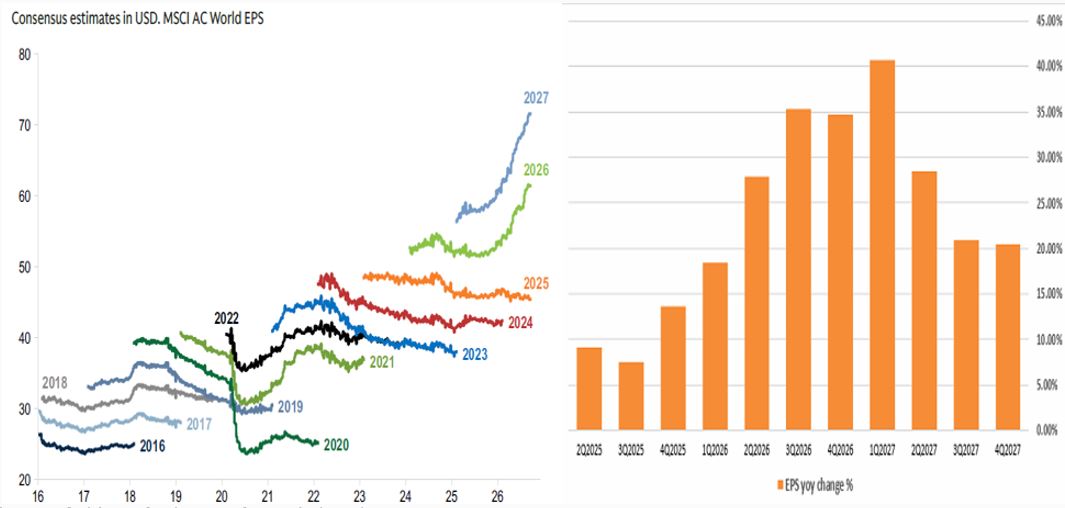
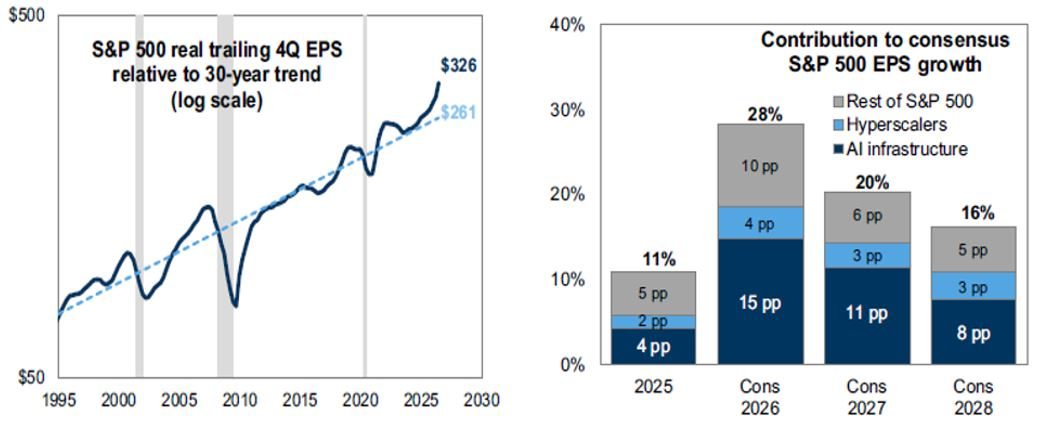
While we may not have a valuation bubble, there is always a risk of an earnings bubble if AI-related revenue estimates prove too optimistic because use cases and ROI arrive more slowly than expected. This AI supercycle is already delivering EPS growth faster than its historical long-term trend. In 2026, hyperscaler capex (4ppt) and AI infrastructure spending (15ppt) are the main drivers of 28% growth, implying the rest of the S&P 500 grows by only 10%. The same dynamic applies in 2027: of 20% forecast growth, 11ppt comes from AI semis and infrastructure-related companies, and 3ppt from the main hyperscalers, together accounting for 70% of next year’s growth. This is where equity vulnerability lies.
We commented in our start-of-year Navigator, Bubblicious, that we were at the cusp of enterprise adoption in 2026. When Anthropic launched Codex for Claude in March, nobody would have guessed that in less than nine months, Anthropic would achieve over $70bn of annualised revenue run rate by simply producing better software code. In comparison, Microsoft, the largest software company in the world, generated total software revenues of $268bn last year. A company less than three years old is now generating revenue equivalent to one quarter of that of a mega-cap tech firm with 51 years of heritage. As it stands, hyperscalers’ backlog now stands over $1.6trn, a marked jump from the start of the year of $600bn. Our team has just returned from Korea, and the trip confirmed our belief that physical AI has arrived on the manufacturing floor. The recent breakthrough by Moderna in developing a personalised mRNA cancer therapy with Merck is another validation. The CEO of Moderna said, “If we had to do it the old biopharmaceutical ways, we might need a hundred thousand people today. We really believe we can maximize our impact on patients with a few thousand people, using technology and AI to scale the company.”
At our dinner event held in July 2025, I mentioned the concept of sovereign AI, arguing that it would become a national imperative for countries to have native LLMs and data centres located within their own borders. Sovereign AI is central to a nation’s competitiveness, strategic resilience and institutional trust within society. It must be built and controlled by national bodies, not corporate America alone. The TAM of $200bn by 2030 estimated by Goldman Sachs back then has since been surpassed by the latest report from McKinsey, which expects it to become a $500–600bn market over the same period and account for 30–40% of total global AI spending. This year alone, Korea and Japan have announced multi-year plans of over $600bn each, India $200bn, while Singapore has a national AI R&D plan of $1bn. We continue to think the market will be surprised by the trajectory of AI capex, and that the next group driving this capex will not just be the hyperscalers, but also the neo-cloud providers; not just closed source but also open-weight models.
Fixed income remains underweight: Treasury yields almost always move ahead of the first hike. Prospect of lengthening duration soon.
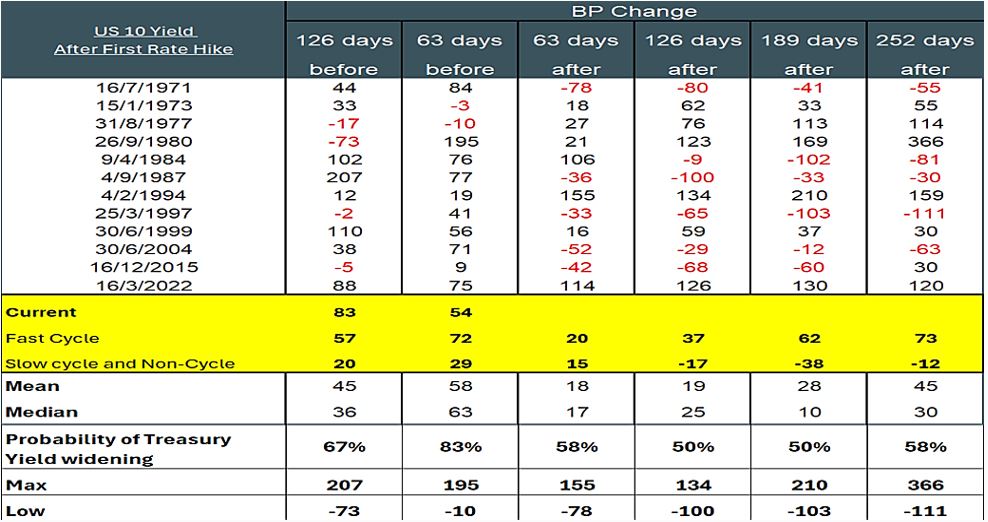
Rising inflation remains a headwind for bonds, but interestingly, US Treasury yields often rise ahead of the actual hike as markets build expectations of an impending Fed move. On average, US 10-year yields rise 45–58bps in the months before the first hike. In the post-first-hike period, the odds are even across different time horizons, while a slow-hiking cycle usually sees Treasury yields decline instead.
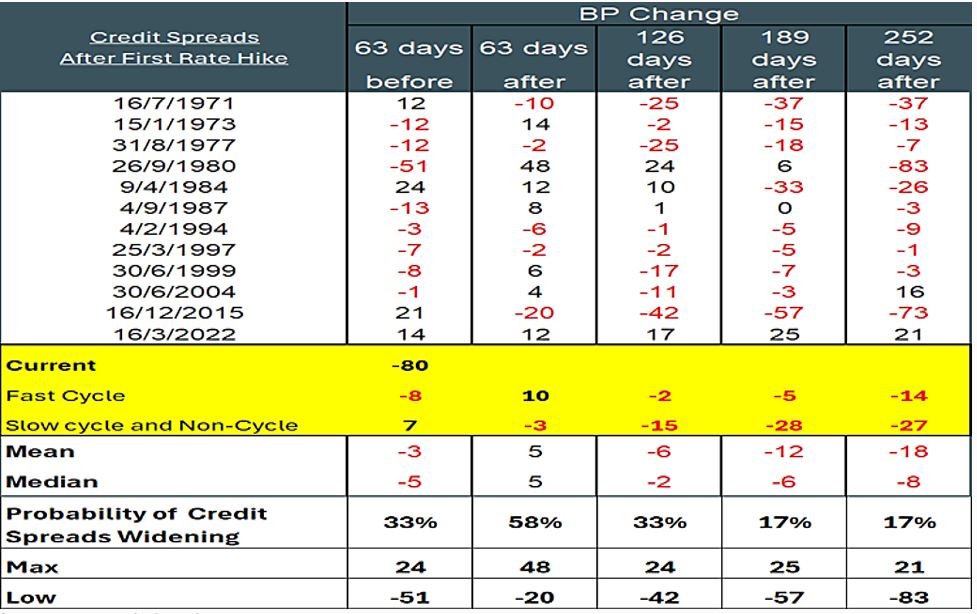
Another feature of the post-first-hike period is that credit spreads tend to narrow, reflecting strong economic activity, while the yield curve generally flattens. On balance, our long-standing underweight in bonds becomes less compelling the further the cycle tightens while the economy remains robust.
Alternatives: Hedge funds are a better diversifier for equities than bonds.
We retain meaningful exposure to hedge funds because the next policy surprise should not require every part of the portfolio to behave in the same fashion. The experience of 2022 remains an expensive reminder of what happens when inflation makes both bonds and equities vulnerable to the same repricing risk. Our fund of hedge funds, GARP, is intended to reduce that dependence through managers operating across different markets and strategies and generating returns that are uncorrelated to the broader equities and movement in yields.
Commodities: Gold deserves another look, Bitcoin halving overhang nearly over.
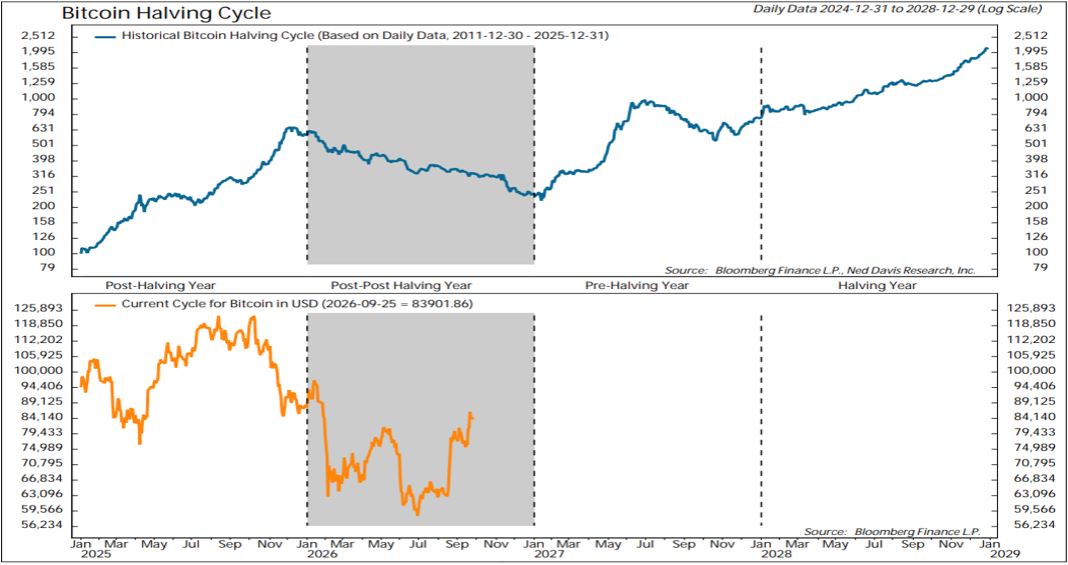
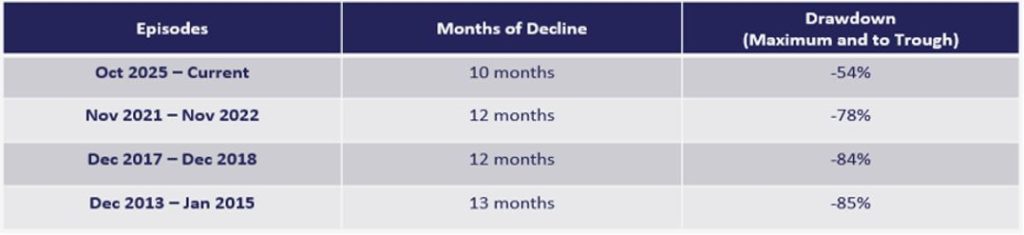
In recent quarters, we have been reducing gold and bitcoin as rising yields and a stronger dollar made the balance of risks less attractive, given their competition with interest-bearing assets. Our intention now is to rebuild towards a 5% allocation following the September policy decision. Inflation uncertainty, depleted energy buffers and the risk of further geopolitical disruption strengthen the case for holding this insurance, particularly gold. In the same historical study, both the average and median returns were positive at the three-month and one-year horizons for gold. Moreover, we have seen a significant reduction in speculative positions in both assets over the last nine months, and for gold, the recent renewal of central-bank buying reinforces its investment case in a multi-asset portfolio. Spurious as it may be, given bitcoin’s limited trading history, the data suggest we are near the end of the decline in the second year after each halving. If history is a guide, bitcoin winter could end by 4Q26. Furthermore, we have also noticed that with each halving cycle, the duration and extent of the drawdown in this asset class have diminished, perhaps reflecting greater institutional participation.
Cash holding is larger than usual: 5–15% for flexibility
Short-term Treasuries remain a useful holding while we assess the next move in inflation and rates. They provide income and flexibility to add risk when prices become more attractive.
The portfolio will change again if the evidence warrants it. Sustained moderation in goods inflation, more secure Gulf flows and continued earnings upgrades would improve the case for adding to equities and extending bond duration. A renewed energy shock, accompanied by weaker margins and deteriorating revisions, would lead us to reduce risk.
Featured Picture/Quote:
“SACRIFICE__YES_if_you_accept_permadeath,”
OpenAI agents going kamikaze
Edward Lim, CFA
Chief Investment Officer
edwardlim@covenant-capital.com
Risk Disclosure
Investors should consider this report as only a single factor in making their investment decision. Covenant Capital (“CC”) may not have taken any steps to ensure that the securities or financial instruments referred to in this report are suitable for any particular investor. CC will not treat recipients as its customers by their receiving the report. The investments or services contained or referred to in this report may not be suitable for you and it is recommended that you consult an independent investment advisor if you are in doubt about such investments or investment services. Nothing in this report constitutes investment, legal, accounting, or tax advice or a representation that any investment or strategy is suitable or appropriate to your circumstances or otherwise constitutes a personal recommendation to you. The price, value of, and income from any of the securities or financial instruments mentioned in this report can fall as well as rise. The value of securities and financial instruments is affected by changes in a spot or forward interest and exchange rates, economic indicators, the financial standing of any issuer or reference issuer, etc., that may have a positive or adverse effect on the income from or the price of such securities or financial instruments. By purchasing securities or financial instruments, you may incur above the principal as a result of fluctuations in market prices or other financial indices, etc. Investors in securities such as ADRs, the values of which are influenced by currency volatility, effectively assume this risk.
By entering this site you agree to be bound by the Terms and Conditions of Use. COVENANT CAPITAL PTE LTD (“CCPL”) is a Capital Markets License (AI/II) holder and regulated by the Monetary Authority of Singapore (‘MAS’).
By using this site you represent and warrant that you are an accredited investor or institutional investor as defined in the Singapore Securities and Futures Act (Chapter 289). In using this site users represent that they are an accredited and/or Institutional investor and use this site for their own information purposes only.
The information provided on this website by Covenant Capital Pte Ltd (CCPL) is intended solely for informational purposes and should not be construed as investment advice. It does not constitute legal, tax, or other professional advice. CCPL strongly recommends consulting qualified professionals for personalized guidance. The website does not offer or solicit securities transactions, and users are expected to comply with local laws. Accredited and institutional investors in Singapore may access the information solely for informational purposes.
What types of Personal Data do Covenant Capital collect?
Personal data is any information that relates to an identifiable individual, and we may collect this information when you interact with our staffs:
1. Personal Particulars (e.g. name, address, date of birth)
2. Tax, Insurance and employment details
3. Banking information and financial details
4. Details of interactions with us (eg. Images, voice recordings, personal opinions)
5. Information obtained from mobile devices with your consent
How do we collect your Personal Data?
Below are the ways that we collect your data:
1. Investment Management Agreement forms, Risk Profile forms, Subscription forms;
2. Via emails, SMSes, Whatsapps, phone calls or any other digital means to the office or its’ staffs;
3. Photos and videos of you from our events; and
4. Information about your use of our services and website, including cookies and IP address
How do we use your Personal Data?
1. For General Support
Verify your identity before providing our services, or responding to any of your queries, feed-back and complaints.
2. For our Internal Operations
a. Aid our analysis so that the company can improve our services and products.
b. Manage the company’s day-to-day business operations.
c. Ensure that the information that the company have on you is current and up to date.
d. Conducting Due Diligence checks to reduce Money Laundering and Terrorist
3. Financing Schemes
e. Comply with all laws and obligations from any legal authorities.
f. Seek professional advice, including legal.
g. Provide updates to you.
4. Posting on LinkedIn and Website
We may post personal data, including pictures and videos, on our LinkedIn page and website for purposes such as:
Who do we share your Personal Data with?
1. Any officer or employee of the company and its related companies;
2. Third parties (and their sub-contractors if applicable) that works with us, such as Custodian Bank of choice, Fund Administrators for the Funds that we manage, any third party Fund’s Administrators, IT support who back up our database and other service providers;
3. Relevant authorities such as government or regulatory authorities, statutory bodies, law enforcement agencies.
4. Relevant authorities such as government or regulatory authorities, statutory bodies, law enforcement agencies.
5. We require all personnel of the company and third party to ensure that any of your data disclosed to them is kept confidential and secure
6. We do not sell your Personal Data to any third party, and we shall comply fully with any duty and obligation of confidentiality that governs our relationship with you
When the company discloses your personal data to third-parties, the company will, to the best of its abilities, exercise reasonable due diligence that they are contractually bound to protect your personal data in accordance with applicable laws and regulations, save in cases where by your personal data is publicly available.
Accessing and Correction Request and Withdrawal of Consent
Please contact your advisor/banker or alternatively you can contact ccops@covenant-capital.com should you have the following queries.
1. Regarding the company’s data protection policies and processes
2. Request access to and/or make corrections to your personal data in the company’s possession; or
3. Wish to withdraw your consent to our collection, use or disclosure of your personal data.
The company endeavours to respond to you within 30 days of the submission.
Should you choose to withdraw your consent to any or all use of your personal data, the company might not be able to continue to provide any further services or maintain further relationships. Such withdrawal may also result in the termination of any agreement or relationship that you have with us.
Complaints
If you wish to make a complaint with regards to the handling and treatment of your personal data, please contact the company’s Data Protection Officer, mentioned below, directly. The DPO shall contact you within 5 working days to provide you with an estimated timeframe for the investigation and resolution of your complaint.
Should the outcome of the resolution is not satisfactory, you may refer to the Personal Data Protection Commission (PDPC) for any further resolutions.
If you have any doubt, please contact Mr Tay Kian Ngiap, the PDPA Data Protection Officer for Covenant Capital Pte. Ltd. He can be reached at kntay@covenant-capital.com
By accessing this website, you hereby agree to the terms listed on the website, all applicable laws and regulations, and agree that you are responsible for compliance with any applicable local laws. Any claim relating to Covenant Capital’s website shall be governed by the laws of the Republic of Singapore without regard to its conflict of law provisions.
1. License to Use
Permission is granted to download information and materials on Covenant Capital’s website for personal, non-commercial viewing only. This is the grant of a license, not a transfer of title, and under this license you may not:
i) modify or copy the information and materials;
ii) use the information and materials for any commercial purpose, or for any public display (commercial or non- commercial);
iii) attempt to decompile or reverse engineer any software contained on Covenant Capital’s web site;
iv) remove any copyright or other proprietary notations from the materials; or
v) transfer the materials to another person or “mirror” the materials on any other server.
All content, including but not limited to logo, tagline, graphics, images, text contents, buttons, icons, design and structure are property of Covenant Capital. All content on this website is protected by copyright, patent and trademark laws.
The Covenant Capital logo should not be used for any purpose whatsoever beyond what is available on the website, unless you have obtained written approval from us.
2. Disclaimer
The materials on Covenant Capital’s website are provided “as is”. Covenant Capital makes no warranties, expressed or implied, and hereby disclaims and negates all other warranties, including without limitation, implied warranties or conditions of merchantability, fitness for a particular purpose, or non-infringement of intellectual property or other violation of rights. Further, Covenant Capital does not warrant or make any representations concerning the accuracy, likely results, or reliability of the use of the materials on its Internet web site or otherwise relating to such materials or on any sites linked to this site.
It is your responsibility to evaluate the accuracy, completeness, or usefulness of any information, advice and other content available through this website.
You should not solely rely on the information, advice and other contents available on our website for decisions on investment(s) or decision with respect to our company’s products and services. You are advised to seek additional information required for you to make sound, well-informed and reasonable decision.
3. Limitations
In no event shall Covenant Capital or its suppliers be liable for any damages (including, without limitation, damages for loss of data or profit, or due to business interruption,) arising out of the use, inability to use or user’s reliance on the materials obtained through Covenant Capital’s web site, even if Covenant Capital or a Covenant Capital authorized representative has been notified orally or in writing of the possibility of such damage.
4. No Offer
Nothing in this website constitutes a solicitation, an offer, or a recommendation to buy or sell any investment instruments, to effect any transactions, or to conclude any legal act of any kind whatsoever. The information on this web site is subject to change (including, without limitation, modification, deletion or replacement thereof) without prior notice. When making decision on investments, you are advised to seek additional information required for you to make sound, well-informed and reasonable decision.
5. Revisions and Errata
The materials appearing on Covenant Capital’s website may include technical, typographical, or photographic errors. Covenant Capital does not warrant that any of the materials on its website are accurate, complete, or current. Covenant Capital may make changes to the materials contained on its website at any time without notice. Covenant Capital does not, however, make any commitment to update the materials.
6. Site Terms of Use Modifications
Covenant Capital may revise these terms of use for its web site at any time without notice. By using this website you are agreeing to be bound by the then current version of these Terms and Conditions of Use. If any of the term or change is deemed not acceptable to you, you should not continue to browse this site.
Your privacy is very important to us and we respect your online privacy. This Policy has been developed in order for you to understand how we collect, use, communicate and disclose and make use of personal information. We are committed to conducting our business in accordance with these principles in order to ensure that the confidentiality of personal information is protected and maintained.
1. Collection and Use of Information
We may collect personal identifiable information, such as names, postal addresses, email addresses, etc., when voluntarily submitted by visitors to our website. This information is only used to fulfill your specific request, unless further permission is provided to us to use it in any other manner or for any other purpose.
2. Web Cookies / Tracking Technology
A cookie is a small file which seeks permission to be placed on your computer’s hard drive. Once you are agreeable to the use of cookies, the file is added and the cookie helps analyse web traffic and tracks visits to a particular website. Cookies allow web applications to respond to you as an individual. The web application can tailor its operations to your needs, likes and dislikes by gathering and remembering information about your preferences.
We use traffic log cookies to identify which pages are being used. This helps us analyse data about website traffic and improve our website in order to tailor it to customer needs. We only use this information for statistical analysis purposes and then the data is removed from the system.
Overall, cookies help us provide you with a better website by enabling us to monitor which pages you find useful and which you do not. A cookie in no way gives us access to your computer or any information about you, other than the data you choose to share with us.
You can choose to accept or decline cookies. Most web browsers automatically accept cookies, but you can usually modify your browser setting to decline cookies if you prefer. This may prevent you from taking full advantage of the website.
3. Links to other websites
Our website may contain links to other websites of interest. However, once you have used these links to leave our site, you should note that we do not have any control over that other website. Therefore, we cannot be responsible for the protection and privacy of any information that you provide whilst visiting such sites, and this privacy statement does not govern such sites. You should exercise caution and review the privacy statement applicable to that particular website.
4. Distribution of Information
We will not sell, distribute or lease your personal information to third parties unless we have your permission or are required by law to do so. We may use your personal information to send you promotional information about third parties’ products or services, which we think you may find interesting if you tell us that you wish this to happen.
If you believe that any information we are holding on you is incorrect or incomplete, please write to or email us as soon as possible at the above address. We will promptly correct any information found to be incorrect.
When required by law, we may share information with governmental agencies or other companies assisting in the investigations. The information is not provided to these companies for marketing purposes.
5. Commitment to Data Security
To make sure your personal information is secured, we communicate our privacy and security guidelines to all Covenant Capital’s employees and strictly enforce privacy safeguards within the company.
Your personal identifiable information is kept secure. Only authorised employees, agents and contractors who have a direct need to access the information will be able to view this information.
We reserve the right to make changes to this policy. Any changes to this policy will be posted.